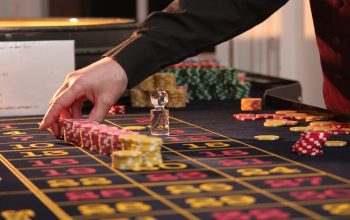
The spinning wheel. The clattering ball. The collective breath held at the table. Roulette is a classic, a symbol of chance and casino glamour that’s been around for centuries. But let’s be honest—for all its excitement, there’s always been a whisper of doubt. Can you really trust the wheel? The dealer? The entire system behind the screen?
Well, that’s where blockchain crashes the party. And it’s not just a quiet guest—it’s flipping the table (metaphorically, of course) and rebuilding the game from the ground up. We’re talking about provably fair decentralized roulette. It sounds like tech jargon, but the concept is surprisingly simple, and honestly, it’s a game-changer.
Breaking the Bank: The Old Problem of Trust
Traditional online roulette, for all its fancy graphics, operates on a central server. A company—or a casino—controls the software, the random number generator (RNG), and all the data. You have to take their word that every spin is random and fair. It’s a black box. And while most licensed operators are legit, the doubt is… well, it’s part of the house’s advantage, isn’t it?
The pain points are real: opaque processes, potential for manipulation, and delays in withdrawals. You’re playing in their system, by their rules. Blockchain flips this script entirely.
How Blockchain Roulette Spins a Different Wheel
Imagine a roulette wheel where every single action—your bet, the spin’s outcome, the payout—is recorded on a public ledger that no one person or entity controls. That’s the blockchain. It’s a transparent, immutable record book duplicated across thousands of computers. This is the backbone of decentralized casino games.
Here’s the deal: in a decentralized roulette game, the logic of the game itself is written into a smart contract. This is just a self-executing piece of code on the blockchain. It automatically runs when predetermined conditions are met. No human intervention. No server to hack.
The “Provably Fair” Magic Trick (Where You See the Secret)
This is the killer feature. “Provably fair” isn’t a marketing slogan—it’s a cryptographic guarantee. Here’s a simplified way it works:
- Before your spin, the system generates a secret seed and a public seed. Think of it like a digital lock and key.
- You place your bet, and you can even add your own client seed to the mix, making you part of the randomness.
- The spin happens. The outcome is determined by a cryptographic function using those seeds. It’s instant and irreversible.
- After the spin, the secret seed is revealed. You—yes, you—can take all the seeds, run them through the publicly available algorithm, and verify that the result matches the announced winning number. Every. Single. Time.
It’s like the dealer showing you the wheel’s mechanics before and after the spin, proving no magnets or tricks were involved. This level of transparency was literally impossible in the old model.
Tangible Benefits: Why This Actually Matters
Okay, so it’s transparent and verifiable. But what does that mean for you, the player? A few pretty big things:
| Feature | Traditional Online Roulette | Decentralized Blockchain Roulette |
| Trust Model | Trust the central operator (blind faith). | Trust the code & cryptography (verifiable proof). |
| Transparency | Zero. It’s a closed system. | Full. Every transaction and outcome is on-chain. |
| Control of Funds | Casino holds your money in its wallet. | You hold your crypto in your wallet until the moment of bet. |
| Speed | Withdrawals can take hours or days. | Payouts are near-instant, handled by the smart contract. |
| Anonymity | Requires personal data & KYC checks. | Often permissionless—just connect a crypto wallet. |
That last point about control of funds is huge. In a true decentralized game, you never deposit into a casino’s “bank.” You interact directly with the smart contract from your own wallet (like MetaMask). The contract holds the bets in escrow for the milliseconds of the game, then sends winnings directly back. The “house” as a middleman for your cash is drastically reduced, if not eliminated.
The Flip Side: Challenges in a Decentralized Casino
It’s not all perfect, of course. This is emerging tech. The user experience can be clunky—connecting wallets, paying gas fees (transaction costs on networks like Ethereum), understanding crypto. The feel of the game sometimes lacks the polish of a major software provider. And regulation? It’s a wild west, which means player protection frameworks are still being figured out.
Plus, true decentralization is a spectrum. Some games are “on-chain” for outcomes but use off-chain systems for the RNG to save costs. Others are fully on-chain. It’s worth digging into a platform’s whitepaper to see how they do it.
What’s Next? The Future Spin of the Wheel
The trajectory is clear. As blockchain tech matures and layer-2 solutions make transactions faster and cheaper, these games will get smoother. We might see hybrid models—traditional casinos offering provably fair tables to build trust. The core idea, that you shouldn’t have to trust, but should be able to verify, is a powerful shift in philosophy.
It moves the focus from “Do I trust this company?” to “Do I understand and trust this open-source code?” That’s a fundamental change. It puts unprecedented power—and responsibility—in the player’s hands.
So, the next time you see a digital roulette wheel, you might just wonder: is it a show put on behind a curtain, or is it a transparent machine, its gears turning in the open light of a public ledger? The intersection of roulette and blockchain isn’t just about a new way to play. It’s about redefining the very idea of fairness in games of chance. And that, well, feels like a bet worth making.